

What shapes a judge? Voices from the bench on diversity, representation
State courts often disclose less demographic information than federal courts, making it harder to assess composition of judiciary, prompting concerns about transparency.
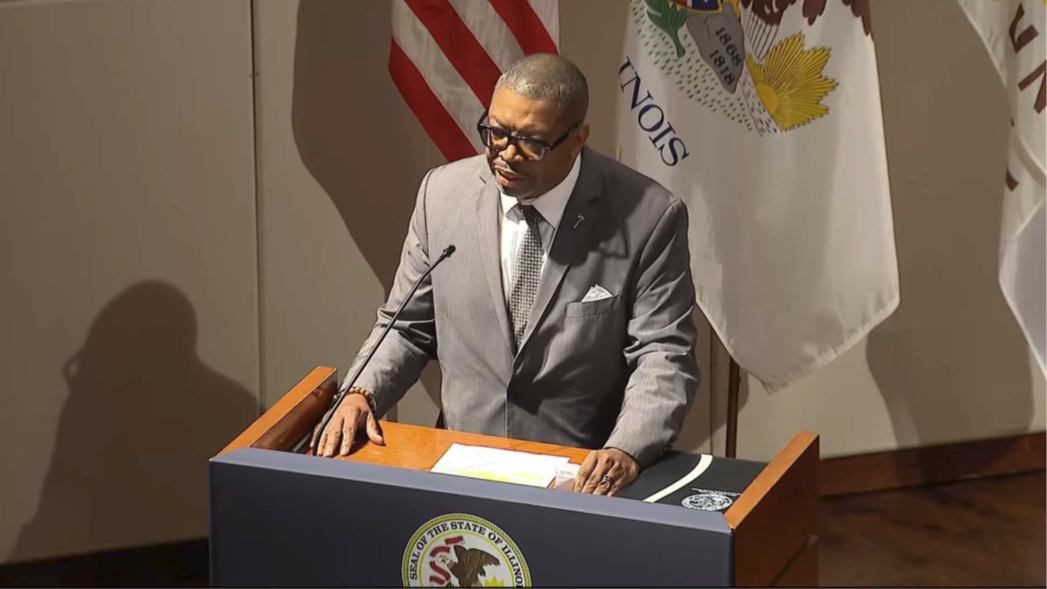
Serving as master of ceremonies, Judge John Fitzgerald Lyke Jr. speaks during the Dec. 1, 2025, swearing-in ceremony for Chief Judge Charles S. Beach II at Chicago-Kent College of Law. Judges Ankur Srivastava, Alfredo Maldonado and Mary C. Marubio also participated in the event. Lyke’s career reflects the growing, though still limited, racial diversity of the Cook County judiciary. (TV image via WGN News/ click: video link
DILEMMAS AMONG JUDGES: Click here for slides
Jack Baker, Bianca Dishmon, Isabella Dumenigo and Alice Tao
Judge John Fitzgerald Lyke Jr., born in his grandmother’s public housing apartment on Chicago’s South Side, now serves on the bench in Courtroom 208 at the George N. Leighton Criminal Courthouse.
“My background is very humble, to put it mildly. I’m from Robert Taylor Housing Projects, as well as [the] Englewood [neighborhood], two of the roughest places in Chicago, particularly back in those days,” Lyke said during a 2023 interview with Chicago-Kent Magazine, describing his upbringing in the 1960s and ’70s.
For Judge Lyke, a sense of responsibility as a Black jurist is rooted in his Christian faith and early life experiences, including exposure to civil rights violations and police misconduct. He has said those experiences shaped his decision to pursue the bench.
Lyke is one of roughly 400 judges serving in Cook County, according to the Circuit Court of Cook County. In 2018, however, Black judges accounted for only about 19% of the county’s judiciary, according to Injustice Watch. Similar representation patterns appear to exist in the Northern District of Illinois, where Black judges make up 19% of the federal bench and minority judges account for 31% overall.
Compared with the federal level, demographic information about state court judges is less accessible and more difficult to compile.
Elizabeth Monkus, program director and senior attorney at the Chicago Appleseed Center for Fair Courts, noted that Illinois courts are “not subject to” the state’s Freedom of Information Act or standard public records requirements.
“You can’t ask the court,” Monkus said. “The court won’t tell you if they’re even keeping that information. They don’t have to tell you, and chances are they’re not going to.”
Issues of transparency raise broader questions about experience and perspective on the bench, including how personal history shapes judges’ understanding of the communities they serve.
‘Elected to be different’
Reflecting on his experiences, Lyke said he understands the realities of “driving while Black” and has also been racially profiled while shopping. Those incidents, he said, inform his perspective as a judge.
“I was elected to be different,” said Lyke, an Army veteran who also presides over the Veterans Treatment Court, part of the county’s problem-solving program.
New York State Supreme Court Justice Hasa Kingo recognizes that racial bias and unequal expectations still exist, often requiring some individuals to work harder to earn the same level of respect. He emphasizes that meaningful change takes time, but consistent preparation, excellence, and professionalism can challenge stereotypes, influence perceptions and promote greater equity and inclusion over the long term. (MEDILL TrialMonitors on April 30, 2026)
Before becoming a judge, Lyke spent six years as an assistant state’s attorney and 15 years working in private practice as a defense attorney.
His perspective differs from and aligns with that of Judge Carol M. Howard, who works several floors above him in the same courthouse. Howard spent 19 years at the Cook County Public Defender’s Office before joining the bench in 2006.
Howard recalled her early impressions of the criminal division, saying, “All the players in the game seemed to be white. All the people in positions of power were white, making decisions about the lives of mostly minority defendants, Black and Hispanic defendants.”
She has also noted progress over time, though she emphasized that representation gaps remain. Women made up just 41% of Cook County’s judiciary in 2018, according to Injustice Watch.
Lyke said that although diversity is “much better” today, “we still have a long way to go.”
“I have seen a tremendous uptick in Black female judges, but I really can’t say the same about Black men,” Lyke said.
Judge Loveleen Ahuja has also highlighted the pressures faced by women of color on the bench, saying they are often expected to “prove our worth” and serve as “the best representation” for their communities. She pointed to moments in court that underscore the value of cultural awareness, including one instance in which a woman requested a new trial date due to fasting. Ahuja recognized it as Ramadan observance, and the woman reacted with visible relief.
“Her eyes just lit up that somebody knew what Ramadan was,” said Ahuja, who assume office in 2024.
More than a dozen judges of diverse racial, ethnic, gender, and sexual orientation backgrounds declined to discuss diversity on the bench, citing concerns about preserving the appearance of impartiality. At the same time, some judges and court observers noted that diversity also includes professional background, which can shape courtroom perspectives.
According to Scott Pollack, court watcher with the Illinois Alliance for Reentry & Justice, most Cook County judges are former prosecutors. Statewide, the ratio of professional backgrounds is more balanced, he said.
Judge Alfredo Maldonado, a former defense lawyer, said he understands the challenges faced by former clients who are desperate and alone.
“They didn’t have any friends; they didn’t have any family. They truly were alone in the world,” Maldonado said.
During his 25 years on the bench, Judge Thomas More Donnelly click: hyperlink has participated in discussions that bring together judges, attorneys, law enforcement, corrections professionals, crime survivors, and formerly incarcerated individuals to examine issues affecting the justice system. (MEDILL TrialMonitors video by Miguel Tsang)
Howard added that her public defender background shapes how she evaluates evidence and testimony.
“I don’t accept anyone’s testimony as fact simply because of their position,” Howard said. “Many times, my clients are telling the truth. Sometimes they’re not. Many times, [police] officers are telling the truth. Many times, they’re not.”
Some say diversity builds trust
Judge Ahuja similarly emphasized that public defense work builds empathy and listening skills. “You really get to learn what empathy is,” she said. “Every single person is more than the worst instant in their life.”
Recalling his work as a defense attorney and former prosecutor, Lyke mirrored Ahuja’s perspective, explaining that “there’s a difference between being a bad person and having a bad day.”
Several judges emphasized that greater racial diversity on the bench can strengthen public trust in the judiciary. Ahuja suggested that when defendants see judges who share their cultural or racial background, it puts them “at ease” and helps “garner more trust in the system.”
Howard agreed, explaining that while she does not privilege defendants who share her racial background, their shared experiences “may make a difference in their ability to accept the outcomes in their cases.”
“I’m sure there’s feelings of being overwhelmed, but it makes a difference when some of the people making decisions concerning you seem to share your background,” she said, adding that diversity is especially important for people appearing in court for the first time. “That makes a difference in how the justice system is perceived.”
Alicia Alvarez, a law professor at the University of Illinois Chicago, said she believes life experiences shape people as both individuals and lawyers.
“Though judges are to apply the law equally, I think different life experiences help with empathy, helping judges [and others in the legal system] understand the situations the people who appear before them find themselves in,” she said in an email.
Jack Baker, Bianca Dishmon, Isabella Dumenigo, Alice Tao