

Burge torture survivor says police abuse was ‘never just one bad actor’
Decades of misconduct allegations and public skepticism have driven recurring reforms to Chicago’s police accountability system.
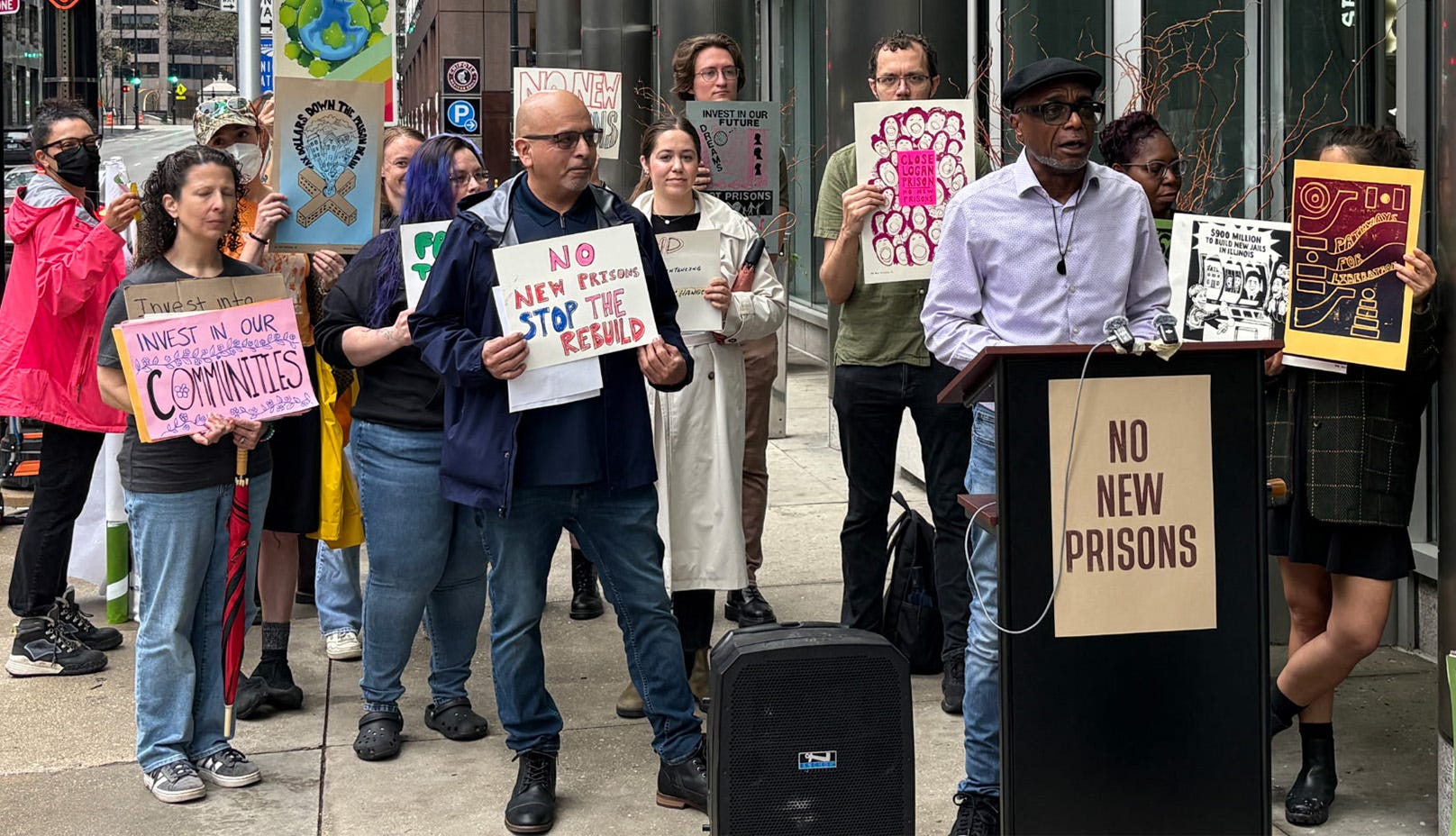
Stanley Howard, a torture survivor from the Jon Burge era, addresses supporters at an April 15, 2026, rally organized by the No New Prisons Illinois coalition to oppose plans for two new prisons in Crest Hill, Illinois. He was joined by James Soto, who, along with his cousin David Ayala, spent 42 years wrongfully imprisoned—the longest such incarceration in Illinois history. (Photo courtesy of Stanley Howard/click: video link
POLICING THE POLICE: Torture, Misconduct and the Systems of Police Accountability in Chicago: Click here for slides
By April Arabian, Grace Gormley, Caroline Gould, Sol Thomas
After Chicago police officers beat and suffocated him with a typewriter cover until he lost consciousness and coerced a false confession, Stanley Howard endured 39 years in prison. He describes the root of the problem as “never just one bad actor.”
“It wasn’t just crooked cops,” said Howard, 63, who was accused of a fatal shooting during an attempted robbery in 1984 and later sentenced to death in 1987. “It was all three branches of government.”
Since Howard, now a prison rights advocate with the Uptown People’s Law Center, was first tortured in 1984,
Chicago’s police accountability system has been repeatedly reformed in response to recurring allegations of police misconduct, public distrust of oversight institutions, and changing political priorities across administrations. Now, its transparency is in question as the Illinois Supreme Court considers whether arbitration hearings in serious police misconduct cases can be shielded from the public.
The appeal stems from a 2024 Cook County Circuit Court ruling that allowed officers facing termination or suspension longer than 365 days to choose arbitration instead of a Chicago Police Board hearing but required those arbitration hearings to remain public — a requirement the Illinois Appellate Court affirmed last August. The Police Board has adjudicated serious disciplinary cases in public hearings since the 1960s.
On Aug. 19, 2024, Stanley Howard and James Soto joined Democracy Now! host Amy Goodman to discuss Chicago’s long and troubled history of police misconduct, including acts of torture carried out under former Police Cmdr. Jon Burge during the 1970s and ’80s.
The appellant, Fraternal Order of Police Lodge 7, argues that Chicago police officers bargained for private arbitration proceedings through their collective bargaining agreement and that courts should not override those contractual protections.
Officers face 21 disciplinary cases
Union president John Catanzara Jr. did not respond to requests for comment.
The Illinois Supreme Court’s decision leaves 21 cases pending, according to the Chicago Police Board — including seven seeking the termination of officers accused of unjustified shootings. Police Board hearings cannot proceed without the accused officer’s consent, and arbitration hearings cannot occur until the court rules.
Max Caproni, executive director of the Chicago Police Board, voiced concerns about arbitration. Since arbitrators are selected with agreement from the city and the police union, “there’s an incentive there to kind of split things,” he said.
Police Board members are appointed for fixed five-year terms, and therefore do not have an incentive to please both sides, according to Caproni.
“Not to say that [the Police Board] is perfect,” he said. “But that’s a big problem with arbitration.”
The current legal dispute sits within Chicago’s broader system for police accountability, a system that has evolved from decades of police abuse, according to the U.S. Justice Department’s investigation into the Chicago Police Department in 2017.
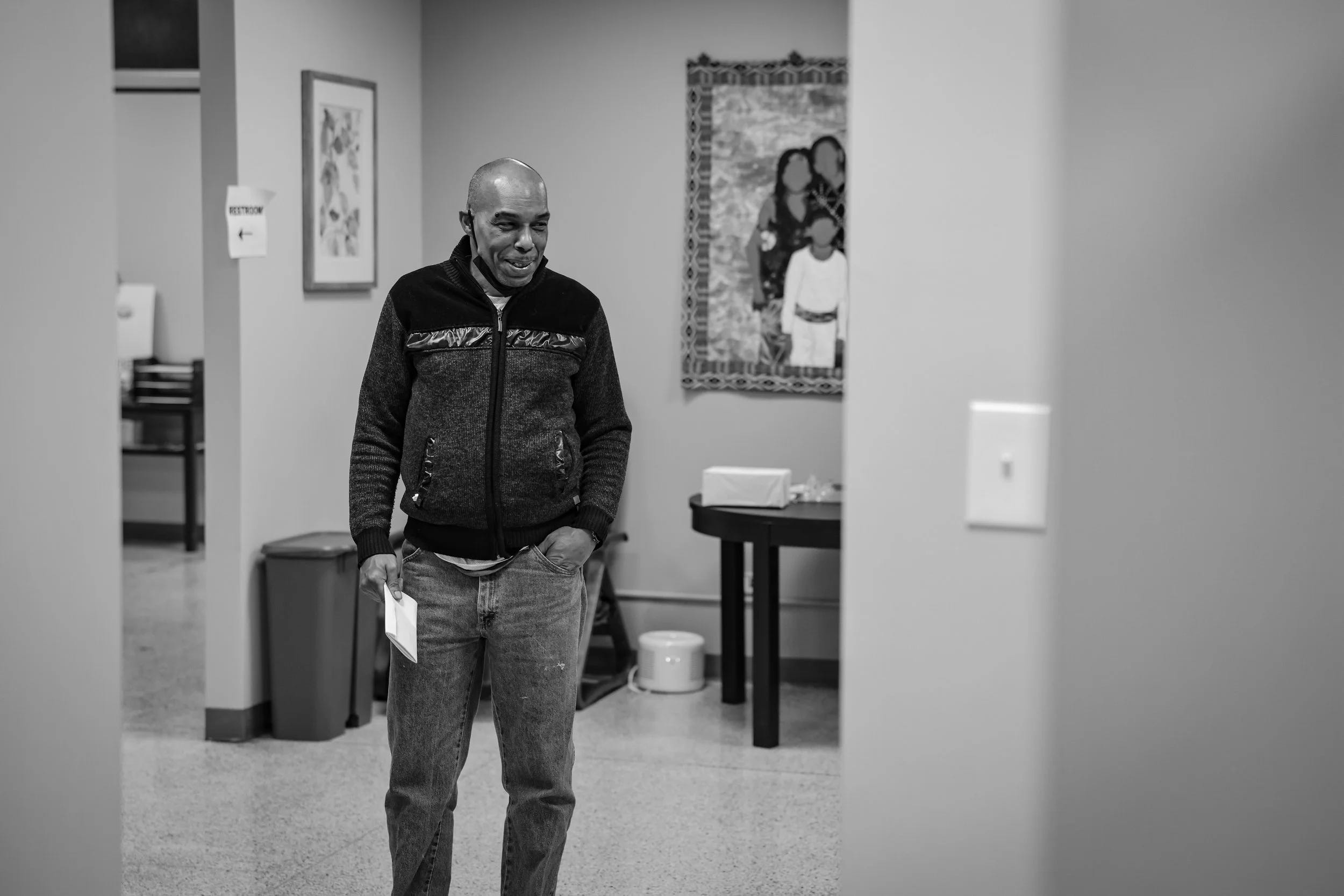
Mark Clements, a well-known Chicago torture survivor, has spent years raising awareness and advocating for justice click: video link for people who were tortured by former police Cmdr. Jon Burge and officers who served under him. (Photo by Jean Melesaine)
The current legal dispute sits within Chicago’s broader system for police accountability, a system that has evolved from decades of police abuse.
From the 1970s into the 1990s, Police Department Cmdr. Jon Burge and his detectives used electric shock, suffocation and other torture methods to extract confessions. More than 120 people, predominantly Black men, were tortured, according to the Chicago Torture Justice Center.
Four natural life sentences
Mark Clements, 62, who spent 28 years in prison after being tortured into a false confession at age 16, said reform has rarely come from institutions without outside pressure.
“None of these things were freely given,” said Clements, who was sentenced to four natural life sentences for the deaths of four people in a fire. “It was given under a lot of sweat and misery by little poor old mothers because their kids had either been assassinated by members of our police department, or they had been wrongfully detained.”
In response to police torture, the Illinois Torture Inquiry and Relief Commission, was created in 2009 to review police torture claims and refer credible cases back to the courts.
Paul Haidle, communications director and supervising attorney with the commission, said that because traditional pathways often fail to address police torture claims, the commission may be a person’s last chance for justice.
“There is essentially no other way if a person has exhausted their appeal and any post-conviction filings,” Haidle said. “This may be the only other avenue available for relief related to the torture aspect.”
More recently, a court order — known as a consent decree — was enacted in 2019 following a federal civil rights investigation that determined Chicago Police Department officers used unreasonable deadly force.
The consent decree requires reforms of CPD’s policies, training and accountability mechanisms. According to WTTW News Reporter Heather Cherone, this decree is one of the most complicated in history.
“The CPD would tell you that they haven’t even really begun to make those changes,” Cherone said. “Police departments, especially the Chicago Police Department, have been notoriously resistant to oversight.”
As of Dec. 31, 2025, the Independent Monitoring Report said CPD is in full compliance with about 25% of the decree’s requirements
Chicago has also expanded civilian oversight through the Community Commission for Public Safety and Accountability, a body whose seven members are nominated through the District Council Nominating Committee and appointed by the mayor. The permanent commission began work in 2024.
Among other powers, the commission has the ability to set and approve policy for the Police Department and the Police Board.
Frank Chapman, educational director and field secretary of the Chicago Alliance Against Racist and Political Repression, has pushed for civilian control over the police since his wrongful conviction in 1961.
“It was a 10-year struggle to get something done about this,” Chapman said.
Chapman said he sees it as “significant reform” to have a civilian body that can “not only oversee police policies, but initiate policies of their own.”
Yet Howard, who spent 16 years on death row, said current changes are not enough compared to the human cost of police misconduct.
“My daughter and my sons had to grow up without their dad and live with the fact that their dad was on death row,” Howard said. How much stress did that put on my mom to lead to an early death?”
As the pursuit of police accountability continues, the Illinois Supreme Court will soon decide whether the most serious police misconduct cases will be open to the public.
“Whether or not the new structures will prevent the next big scandal,” Cherone said, “I don’t have a crystal ball.”
April Arabian, Grace Gormley, Caroline Gould, Sol Thomas