

Rising costs may leave pro se litigants at a disadvantage

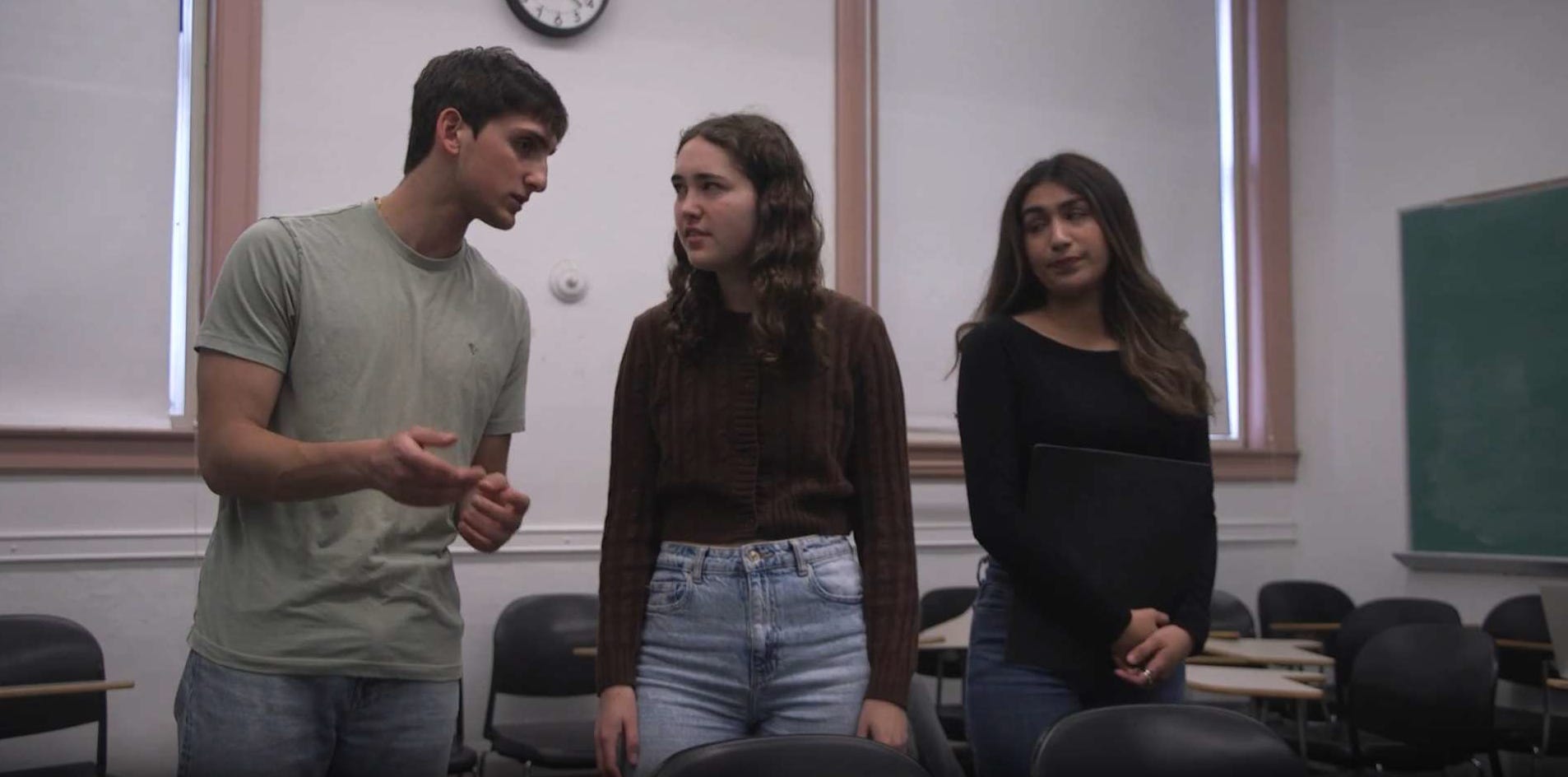
From left, reporters Michael Capobianco, Cassandra Brook and Jezel Martinez portray an Italian interpreter, a defendant and a defense attorney, respectively, in an educational video about the pre-trial process.
Who’s Who in the Courtroom: (video wrap-up)
Skit 1: Violating Pre-Trial
Skit 2: Bank Heist Witness
By Cassandra Brook, Michael Capobianco, Jezel Martinez, David Sun, Sophia Zhang
Issues that shape daily life, including housing, safety, family and civil rights, are often neglected in the legal system, said Alison D. Spanner, director of the Access to Justice and Strategic Planning Division of the Illinois Courts. Despite reforms and limited resources, the civil justice system remains out of reach for many who need it most.
While the Supreme Court guarantees all criminal defendants have the right to counsel if they cannot afford it, no such standard exists for civil cases. According to the 2022 “Justice Gap Study,” nearly half of those surveyed did not seek help for at least one of their recent civil legal problems, citing concerns over cost.
Professor Danielle Hamilton, director of the Carter G. Phillips Center for Supreme Court and Appellate Advocacy at the Northwestern Pritzker School of Law, leads a clinic that assists self-represented, otherwise known as pro se, plaintiffs in civil rights appeals in circuit courts nationwide. She emphasized that financial resources play a significant role in courtrooms.
“For civil cases, it is about who has more money because you're fighting for money, and the only way to win the money is to have money initially, to get somebody to fight for your money,” Hamilton said.
Further, few attorneys offer pro bono services, where individuals who cannot afford legal services are represented for free.
“A lot of attorneys are going to firms that focus heavily on commercial work and high-paying clients,” Spanner said. “Particularly in metropolitan areas like Cook County, [many lawyers] go to big law firms that no average person would be able to hire.”
According to paralegal and manager of the Hibbler Help Desk Oliver Levy, pro se litigants in civil court are at a “definite disadvantage.” This virtual help desk is staffed with volunteer attorneys who help these litigants free of charge.
“If you are suing a huge corporation with a massive stable of corporate attorneys, the deck is stacked against you,” Levy said.
The deck is stacked against pro se litigants in other ways, as judges often hold them to the same standards as attorneys, said Karla Chrobak, director of legal services at CARPLS, a Chicago-based legal service that offers advice, brief services or referrals to self-represented litigants.
“I think there’s an imbalance of power,” said Maurice McFarlin Jr., senior instructor at Northeastern Illinois University in the justice studies department. “I think one of the challenges is how the judge and jury view [pro se litigants].”
But Levy views cost as the primary barrier to fair access to justice, leading individuals to navigate the legal system alone.
“Every person who calls wants an attorney, but there is such a sparse landscape of legal resources, and getting actual representation is not realistic for most litigants,” Chrobak said. “I’m not sure that many have the choice to represent themselves.”
To help mitigate the cost barriers to justice, the Illinois Supreme Court made amendments to Rule 298 in 2023 to expand statewide access to an application for court fee waivers in civil cases. Spanner said the Illinois Court Help team has received feedback suggesting that the process is harder than it seems.
Illinois Court Help, a free service established by the Illinois Courts in 2021, provides litigants with guidance on court procedures, required forms and legal resources. Through a phone call or online chat, individuals are connected with trained court guides, who offer legal information, not advice.
Spanner said the non-uniformity and amount of judicial discretion involved in the fee waiver application make it difficult for her and her 15-member court guide team to assist court patrons.
She said they will be hosting three or four listening sessions this summer with individuals who are “intimately involved” with helping others receive fee waivers, or have worked with communities that often seek fee waivers, in hopes of creating a more accessible experience for litigants.
At CARPLS, Chrobak and her team of practicing attorneys help clients by drafting motions, preparing documents and making referrals. Chrobak describes her role as “matching the neediest to those few resources that we do have.”
Among those in greatest need, Hamilton identifies incarcerated individuals as an especially vulnerable population, who often represent themselves. Hamilton mostly works with incarcerated individuals in civil rights cases in the appellate jurisdiction.
“They’re not getting their medication, they’re not getting the proper food, they’re being injured on the job, other people are beating them up,” Hamilton said. “This is a forgotten population where people have turned a blind eye.”
She emphasized incarcerated individuals are often overlooked in the legal system and deserve to be treated like human beings. She said she hopes the public will come to see the real harm they’ve endured.
“I feel honored to be able to help them get the justice that I think they deserve,” Hamilton said.
Cassandra Brook, Michael Capobianco, Jezel Martinez, David Sun, Sophia Zhang