

Mental health issues plague Illinois courts

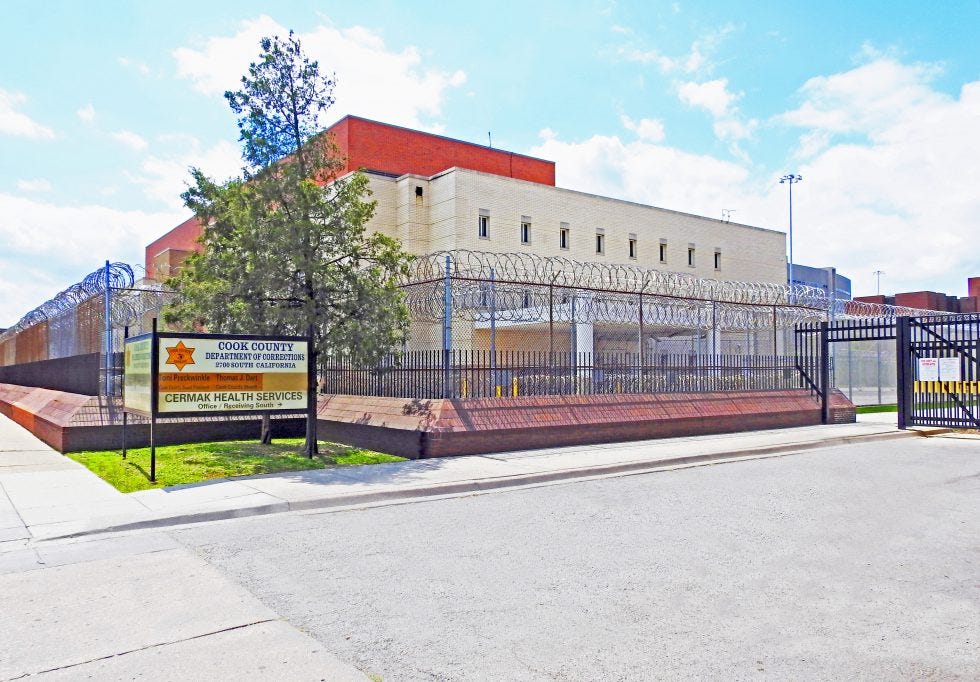
Cermak Health Services, the second largest single-site correctional health service in the United States, provides care to the detainees at the Cook County Department of Corrections.
By Valerie Chu, Sarah Lonser, Eric Smith
A defendant fidgeted at the stand before Skokie Courthouse Judge Paul Pavlus. Before he left the courtroom with his misdemeanor charge dismissed, Pavlus said, “I hope that you come out not through that door but rather through the front door to say hello.”
On the stand, the public defender described her client’s struggles with mental illness. While detained on a previous charge, he was treated at Cermak Health Services at the Cook County Department of Corrections. Detention is just one outcome for people awaiting trial, especially after a measure was implemented to keep people out of jail when they can’t afford to pay bail.
In February 2021, Illinois Gov. J.B. Pritzker signed the Pretrial Fairness Act (PFA) into law, eliminating cash bail. This ensures defendants are eligible for pretrial release, changing the process by which attorneys represent their clients.
“Every defense lawyer will tell you it is far more difficult to defend someone who is incarcerated,” said Steven Lubet, former attorney and Northwestern University professor of law emeritus.
Latisha Wright, a post-release officer at the Skokie Courthouse, said individuals who are released awaiting trial are assigned to an officer like herself, depending on the conditions of their release. Wright, who also works as a pretrial officer at the George N. Leighton Criminal Court Building in Chicago, said the implementation of the PFA has made the pretrial process “more fair.”
While the PFA may increase fairness, as Wright said, it also forms an intersection with mental health courts and defendants with mental health issues.
According to the American Psychological Association, 64% of jail inmates are affected by mental illness. Those residing in jails are most often awaiting trial or sentencing, as it is one of the possible pretrial outcomes. Additionally, Cook County Assistant Public Defender Jeanne Bishop said “at least half of [her] clients are affected with some sort of mental issues.”
“There are a number of programs and strategies being explored that are intended to provide individuals who find themselves in the criminal justice system with an opportunity to seek treatment before having a case adjudicated in the system,” Sharon R. Fairley, University of Chicago Law School professor from practice, said.
Most of the existing resources for those struggling with mental illness are found in and around mental health courts, not the state’s attorney’s office, according to Cook County State’s Attorney Kimberly Foxx. She said even when someone is found unfit to stand trial, her office has little control over the treatment modalities to get them ready for trial.
“On the misdemeanor level, we have very little resources to deal with the mental health issues that we face,” Foxx said. “But our office does not have the capacity — and it is not assigned the responsibility outside of our diversion programs — related to treatment of those suffering from mental illness who come through our courts.”
Though there are some resources available to those struggling with mental health issues, it is important that those in need are actually able to receive those resources, according to Matthew McLoughlin, a co-founder of the Chicago Community Bond Fund and a coordinator at the Illinois Network for Pretrial Justice.
“You can’t provide treatment to people when they’re in a cage,” McLoughlin said. “It’s antithetical to the idea of actually providing care.”
Part of that effort has to be addressed before the pretrial stage, which is what Jessica Gimeno does as a mental health policy analyst at Access Living, a member organization of the Illinois Network for Pretrial Justice, which helped pass the PFA.
“In a system where people don't expect to interact with mental health support unless they are in a deep crisis, this creates problems,” Gimeno said. “So we want to intervene as early as possible in the process so that people can get care.”
One of the projects Gimeno works on is the implementation of the Community Emergency Services and Support Act (CESSA), which requires emergency response operators to help dispatch a team of mental health professionals instead of police to callers seeking mental and behavioral health support.
“CESSA and the Pretrial Fairness Act — they're both positive tools in the system geared toward increasing access to mental health support and decreasing interactions with the criminal justice system,” Gimeno said.
According to Illinois Network for Pretrial Justice’s McLoughlin, the Pretrial Success Act, a bill currently in process, will continue to support these goals through a $15 million appropriations request that will expand access to health and human services for people awaiting trial, another step in reforming the criminal justice system.
University of Chicago’s Fairley said, “The challenges inherent in addressing mental health issues prior to someone entering the criminal justice system and while they are in the criminal justice system are most definitely an area with great potential for reform.”