

The formerly incarcerated turn to services to navigate reentry barriers

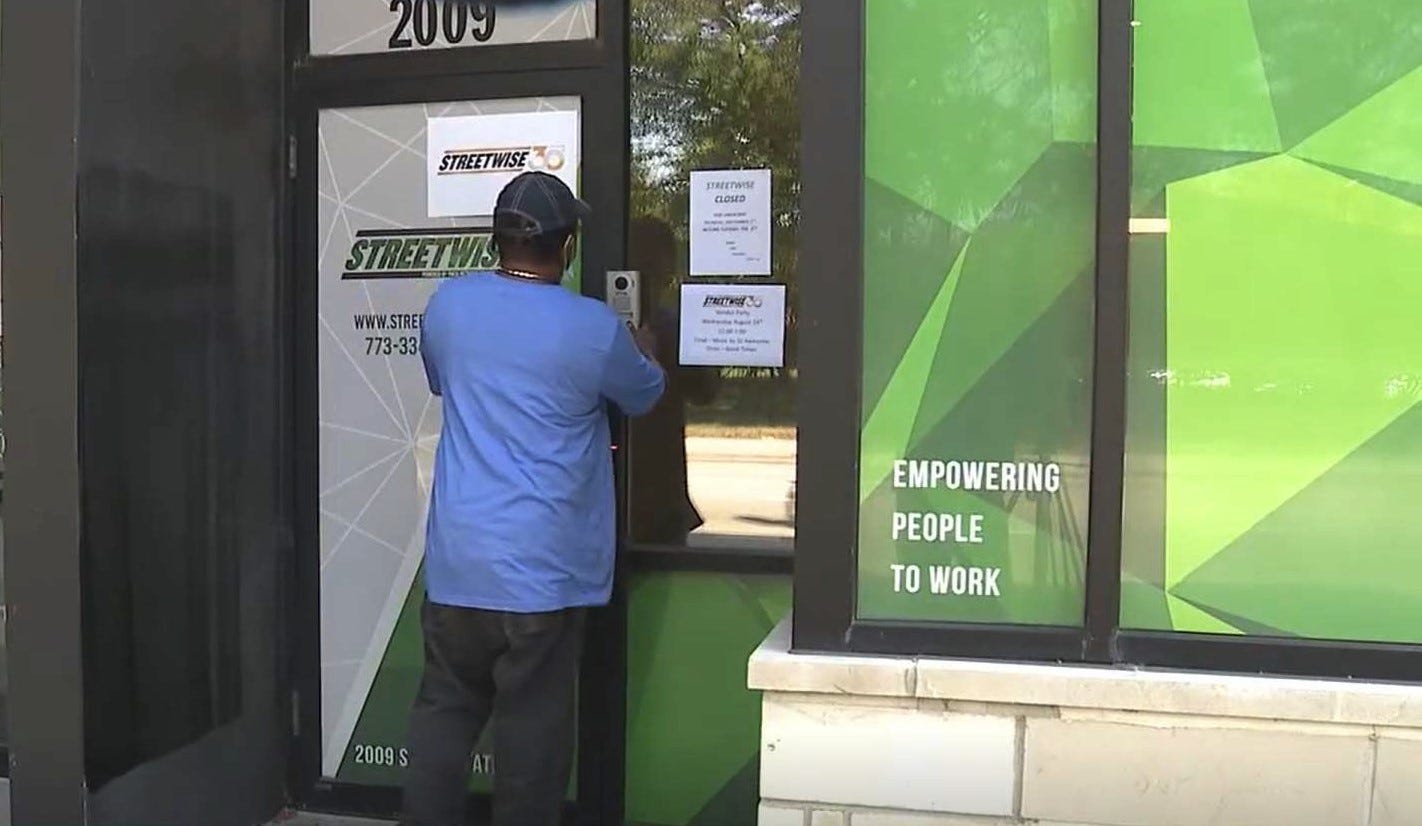
StreetWise, a grassroots journalism outlet, provides income and a community for roughly 125 vendors with lived experience of homelessness, poverty and inequality, including those who are formerly incarcerated. (TV image via FOX 32 Chicago)
THE CRIMINAL LEGAL SYSTEM: Click here for slides.
By Lyric Benford, Arlette Correa, Eunice Lee and Sai Trivedi
On the day someone leaves prison, that freedom is often paired with immediate obstacles: finding housing, securing employment, avoiding recidivism, reconnecting with family and managing stigma. These challenges can feel daunting without proper support.
Xavier Perez, an assistant professor at DePaul University and co-founder of its Criminology Department, has researched these barriers extensively. He explained that many returning citizens face health issues, including struggles with physical ailments and seeking medical care.
Beyond these hurdles, Perez also pointed to the deeper question of societal acceptance.
“One of the challenges of reintegration is whether we willing to accept these individuals back into a moral society where we don’t think about them as sort of these evil connotations?” Perez said.
Kyle Morrison, an assistant Cook County public defender, sees this issue play out particularly in drug cases. He described a cycle where people return to the same pressures that led to their initial convictions and then reverted to familiar habits.
“It’s not a drug use problem, it’s an opportunity problem,” Morrison said.
Perez and Morrison both highlight how reentry is shaped less by individual inadequacies and more by systemic failings. Despite these challenges, there are organizations working to close those gaps and ensure people don’t need to navigate reentry alone.
Reentry Resource Program
When Steven Scotti began reentry in 2024, he didn’t know what the internet was. While at Danville Correctional Center, Scotti was connected to the Reentry Resource Program’s Mapping Your Future guide, which became his roadmap through a society he felt disconnected from.
Now serving as an advisory committee member of the organization, Scotti helps improve the materials he once relied on, drawing on his own experiences to provide comprehensive and individualized support.
“To see the information that I contributed helping somebody navigate an area of reentry in a meaningful way is really important to me,” Scotti said.
The Reentry Resource Program – part of the University of Illinois Urbana-Champaign’s Education Justice Project – was created at the request of formerly incarcerated students who were struggling to find support services.
“They said to us, ‘You all are researchers and professors and writers, why don’t you all create a resource for us?’ So, we did,” said Lee Ragsdale, director of the Reentry Resource Program.
The team is celebrating the 10th edition of its nearly 200-page guide, updated yearly. It covers everything from finding housing and employment to dealing with post-incarceration trauma.
“People come out and feel like they have to do everything all at once, and they don’t know where to begin,” Scotti said. “The guide breaks it down for them in much more digestible amounts.”
Advisory Committee Member Jay Villa called the program’s materials a “gold standard” for those recently released.
“It was really good to see an organization with a focus on the actual human being and making sure that it was relevant with people who had lived experience,” Villa said.
Both Villa and Scotti acknowledged the stigma that causes formerly incarcerated people to build a “mental wall around themselves” and avoid accessing resources over fears of being verbally accosted. Ragsdale, whose husband is system-impacted, said that limited autonomy while incarcerated can leave people afraid to advocate for themselves once they return home.
Villa believes the Reentry Resource Program not only solves these issues but also enhances safety that benefits the public good.
“If people are working, they’re happy and they’re stable, they’re less likely to reoffend,” Villa said. “More police on the streets aren’t preventing crime because they show up after the crime has occurred. Real crime prevention is support for marginalized people of any kind, including those reentering.”
StreetWise
As dawn settles over Kenosha, Wisconsin, Charlie Ross leaves his apartment bundled up with a hat, gloves and hand warmers. He walks to the train station, rides nearly two hours to Chicago to pick up StreetWise magazines, then boards another train north. By 9:30 a.m., Ross is outside Bennison’s Bakery in downtown Evanston, selling magazine copies for $3 apiece.
“Some days I make $75, some days I make like $12 a day,” Ross said. “But it’s enough to keep groceries in my refrigerator, keep my transportation going, pay my light bill and phone bill.”
StreetWise, a grassroots journalism outlet, provides income and a community for roughly 125 vendors, many formerly incarcerated or with lived experiences of homelessness, poverty and inequality.
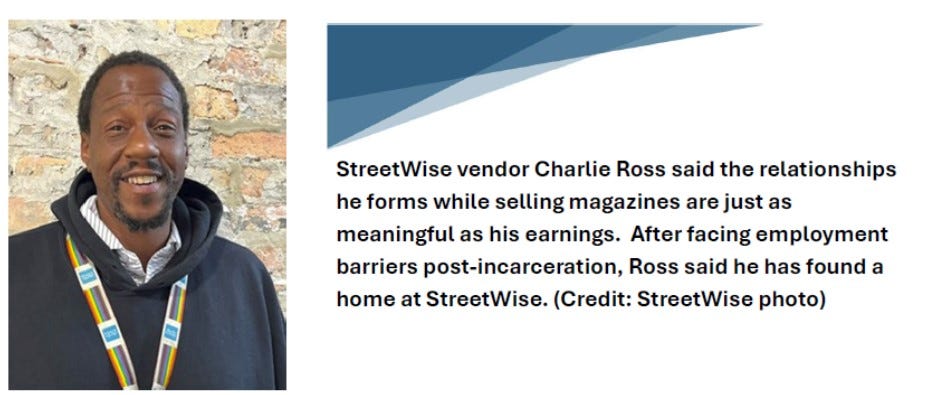
Before working for the magazine, Ross slept in a tent on the beach. Just over a year ago, while stopping at a Mariano’s grocery store to buy a beer, he met a StreetWise vendor who told him about the organization.
“I was a little apprehensive at first, thinking that this was not gonna help me, I’m not gonna sell papers,” Ross said. “But it worked out, and I was able to make enough money to pick myself up.”
Describing himself as a “hustler by trade,” Ross has found a home at StreetWise after encountering employment barriers post-incarceration.
“StreetWise doesn’t discriminate,” Ross said. “Instead, they say, ‘Come on in, you’re part of the family.’”
For Ross, the relationships he builds while selling magazines are just as meaningful as his earnings. Regular customers greet him by name, and he said smiling and waving at people “makes my day.”
Julie Youngquist, executive director of StreetWise, said forging personal connections with vendors has been the organization’s “secret sauce” since its founding 33 years ago. Ross agrees, having formed a kinship with countless vendors.
“There’s so many different personalities, and they come from all different walks of life,” Ross said. “It’s one big family. If you could meet them all, you would love them all too.”