

Problem-solving courts offer jail-free paths for justice-impacted veterans

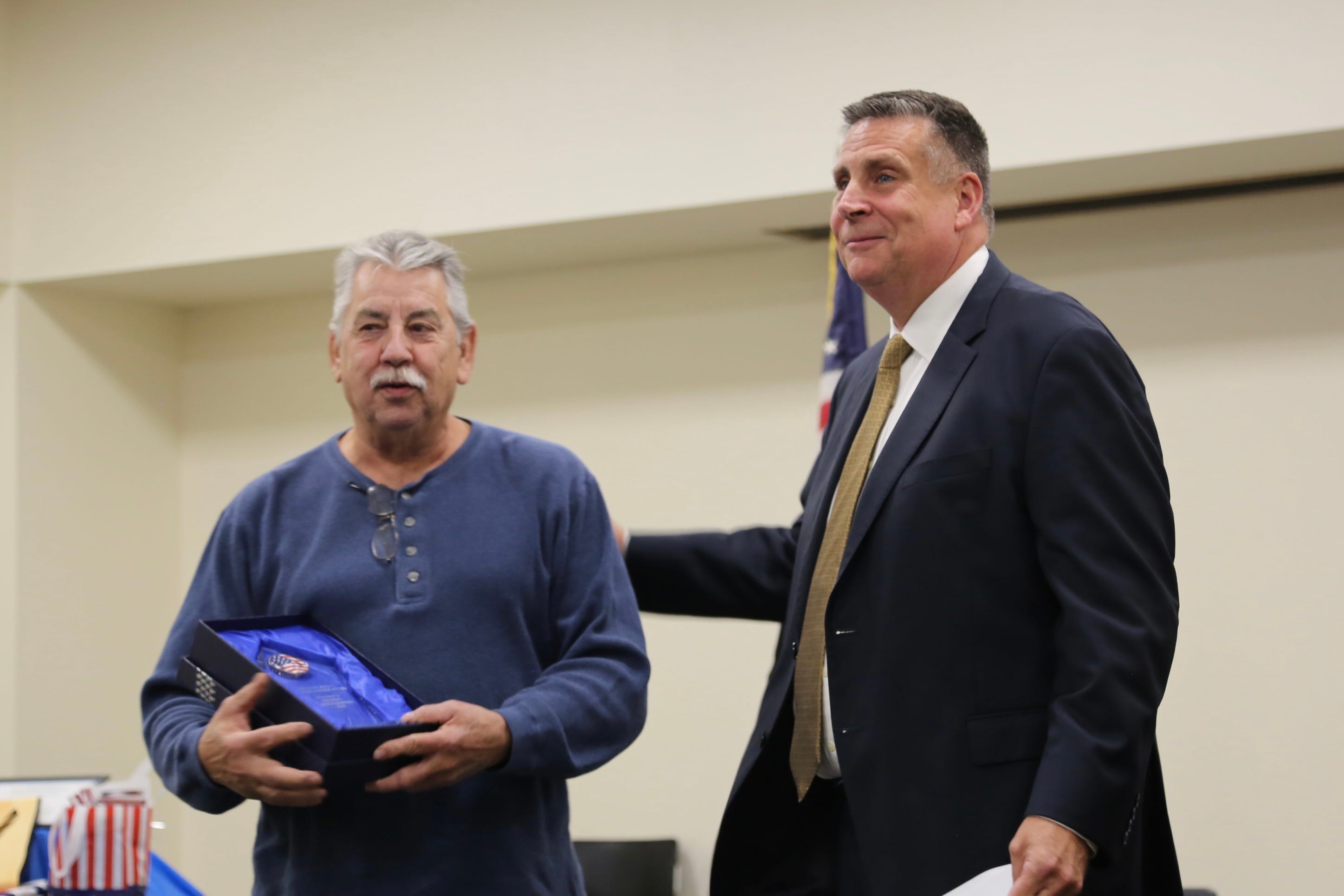
Judge Michael Hood presents the Alma Roque award to Michael Wronkowski, a woodworker and retired deputy sheriff, during the Nov. 7 Veterans Treatment Court graduation at the Skokie Courthouse. Wronkowski crafted plaques for the graduating veterans. (Photo by Ben Shapiro/MEDILL TrialMonitors)
VETERANS AND CARCERAL SYSTEM: Click here for slides.
By Ben Shapiro, Finn Hazen, Baylee Krulewitz and Eleanor Song
After Manuel Gomez returned home to Los Angeles County from serving in the U.S. Navy, the injury he brought back with him sent him down what he now calls a “dark path.” The medication he was prescribed for the pain spiraled into addiction, and his addiction brought him to court.
Without treatment or support, Gomez eventually wound up facing a five-year prison sentence. He called the experience a “reality check” — one that offered no veteran-specific services, despite his repeated asking for help. He said he had to navigate withdrawal, trauma and recovery largely on his own.
After leaving prison, Gomez set out to ensure other veterans don’t have to make a similar journey alone. He now serves as the founder of VetPhoenix, a nonprofit dedicated to empowering justice-impacted veterans. Gomez has become an advocate for veterans rehabilitation programs and treatment courts designed to keep veterans out of jail — the kind of help he wishes he had known about when he needed it most.
“A veterans court, at its most simplistic form, is to be a vehicle toward healing, not a vehicle toward retributive accountability,” Gomez said.
Gomez’s hope reflects a broader shift within the criminal justice system. Across the country, some courts have created pathways for individuals found guilty of crimes that don’t include jail time. In Chicago and its suburbs, rehabilitation is becoming an increasingly popular option through specialized problem-solving courts.
Cook County has more than five times the number of problem-solving courts than any other county in Illinois. As laid out by the National Institute for Justice, these courts are led by a team of individuals in the justice system — from judges to probation officers — to expedite cases, lessen caseloads and reduce recidivism. The courts deal with issues ranging from drug abuse to mental health concerns to veterans’ affairs.
In one Cook County courthouse, Judge Michael Hood presides over the Veterans Treatment Court. A Marine veteran himself, Hood said the primary goal of the problem-solving court is to help “fix” offenders, rather than putting them in prison.
“I think we, as a society in the United States of America, have some obligation to help those guys who, when we say, ‘Hey, go over there and fight in a war,’ they say, ‘OK,’” Hood said.
Hood said the Veterans Treatment Court at the Skokie Courthouse is a one-and-a-half to two-year-long program. Veterans complete four phases during which they are required to report to their probation officer to work toward rehabilitation.
Hood said the problem-solving court focuses on two umbrella issues its program members are most likely to face: mental health concerns and addiction. The program’s goal is to provide services that are often unavailable to justice-impacted individuals in jails and prisons.
“Why send a veteran to prison to get nothing when they can go to our court?” Hood said.
On Nov. 7, the Skokie Courthouse held its biannual graduation ceremony from the Veterans Treatment Court. Both an Army and an Air Force veteran accepted their diplomas and expressed appreciation for Hood and the problem-solving court personnel.
Christine Bookwalter, an assistant public defender in Cook County’s felony court rotation, was honored at the event for her work with the Veterans Treatment Court. She said problem-solving court is important because it’s a “different kind of approach” to the law — a way for veterans to receive help, rather than punishment, as they return to civilian life.
“This really gives them an opportunity to work through what their problems are, so that they can go on and do great things,” Bookwalter said. “This enables them to move past whatever happened that brought them into court and get the treatment that they need and deserve.”
The assistant public defender added that the purpose of the Skokie Courthouse’s Veterans Treatment Court is not to give veterans a “free pass.” Rather, it is to help those who have served the country turn their lives around without the burden of a felony conviction hanging over them for the rest of their lives.
Representatives from related veterans support groups were present at November’s graduation ceremony. Milagros Santos, a nurse for the U.S. Department of Veterans Affairs who works with the Homeless Patient Aligned Care Teams, cheered on both veterans as they graduated from the problem-solving court.
Santos works with the VA to provide medical services to veterans in need. She said the Veterans Treatment Court, in partnership with her own work — traveling around the greater Chicago area
to immunize those who have served the country and provide post-operative care, among other medical tasks — is vital to ensure the well-being of veterans when they return home.
“We recognize that not a lot of the veterans are able to go to the hospital,” Santos said. “So we reach out to them. We go to them.”
Santos said she was happy to support the graduates and appreciates the Cook County court system for helping veterans.
Once a veteran graduates from the problem-solving court, their charges are dismissed and expunged. Hood said the success stories are the reason why he loves the program.
“There’s a million reasons to get behind it,” Hood said. “If you love veterans, you can get behind it. If you’re a money guy, you can get behind it. And the recidivism is great.”